Games
Approaching public health challenges from different perspectives
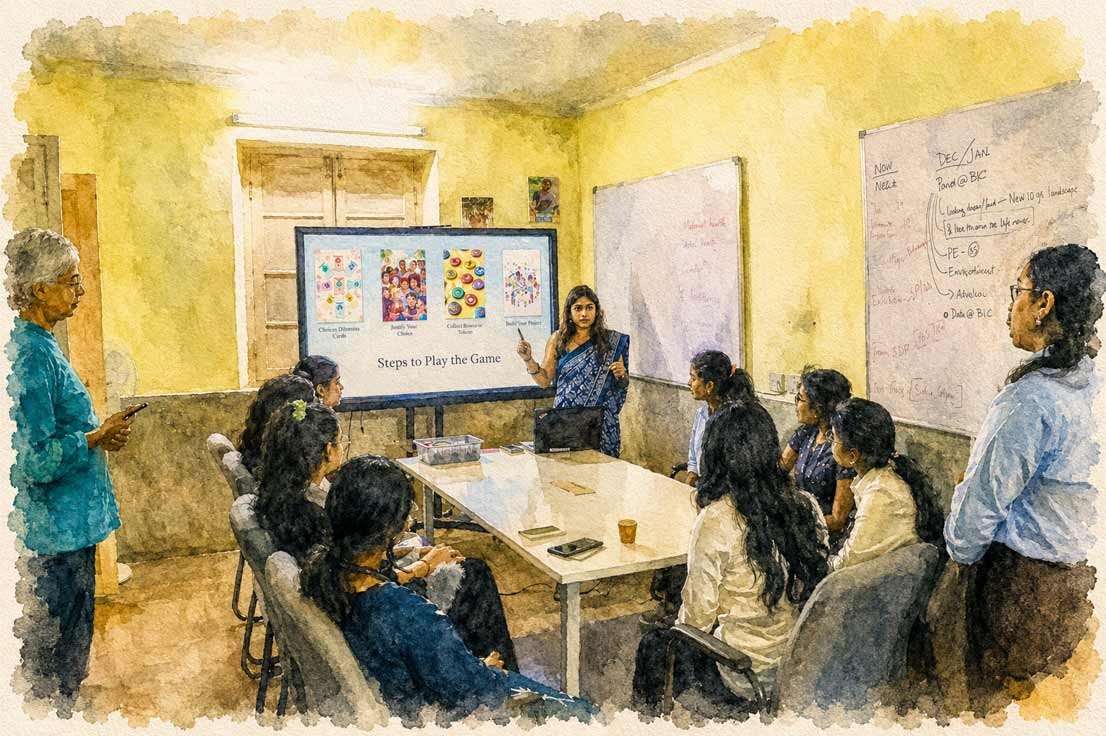
Understanding and integrating key concepts such as the social determinants of health, well-being, and equity is central to public health education and practice. While these concepts are relatively easy to grasp at a definitional level, their meaning becomes more complex when examined in the context of real lives, lived experiences, and everyday decision-making. We have developed two games that approach public health challenges from different perspectives, in scenarios that are grounded in research that has been conducted at the Centre.
In Sankrama (crossroads, in Kannada), participants take on the role of an individual, usually from marginalised households, who live in a challenging environment and are facing a health crisis. Participants discuss and make decisions at successive stages, with each decision producing cumulative consequences with effects on health, income, debt, and social status. The game illustrates how health outcomes are shaped by identity, infrastructure gaps, informal power hierarchies, and broader social determinants such as gender, nutrition, employment, and living conditions.
In Arogya Ayke (health choices, in Kannada), participants assume leadership roles in a simulation inspired by political strategy games. Participant teams are presented a public health dilemma with two possible policy and/or programme solutions. Teams engage in timed decision-making exercises that require them to allocate limited resources, navigating trade-offs between short-term emergency responses and long-term structural reforms, and between equity and political feasibility.